What if Pinterest could sell your stuff for you?
Sounds crazy, right?
Many people think Pinterest is just for recipes and home décor, but beginners can easily sell digital products there too.
In this guide, I’ll show you exactly how beginners are using Pinterest to turn pins into profit, step by step.
Step 1: Your Sales Funnel – Sell Digital Products on Pinterest Indirectly
Pinterest is not a marketplace, it is not social media (even though it’s often considered one, it’s more of a visual search engine than social media), and it is not a platform where you can sell directly.
But Pinterest does let you attach a link to your pin (the image), which sends a user to a landing page where the sale can happen.
So yes, you can sell on Pinterest, but it happens indirectly.
Where do you actually sell?
You have many choices, and it really depends on you. If you are curious about what I use, I have a blog that explains the Fourthwall website builder.
Step 2. Set up a Business Account
First of all, you cannot use a personal Pinterest account if your intention is to sell digital products on Pinterest. Using a personal account is against their Terms of Service.
Also, if you want a successful business, you cannot waste time on what does not work.
So how do you even know what does not work?
Analytics.
Convert your account into a business account (it is completely free) and the analytics will appear.
Use them.
They show in plain sight what you are great at and what users love. They also reveal what users do not like and where you should save your precious time by ditching those pins.
Step 3. Your Designs Matter More than You Think
Recently, I saw a post on Reddit from someone asking for help. They said they were doing all the best practices, but their account just wasn’t growing. In fact, their impressions were decreasing.
I wrote a long, helpful answer, and the next day I noticed that the person had followed my Pinterest account from Reddit. (If you are reading this, you are awesome! Don’t get mad that I’m using your example, I believe it will help all of us.)
I checked their account and saw that there was a lot of work… just in the wrong direction.
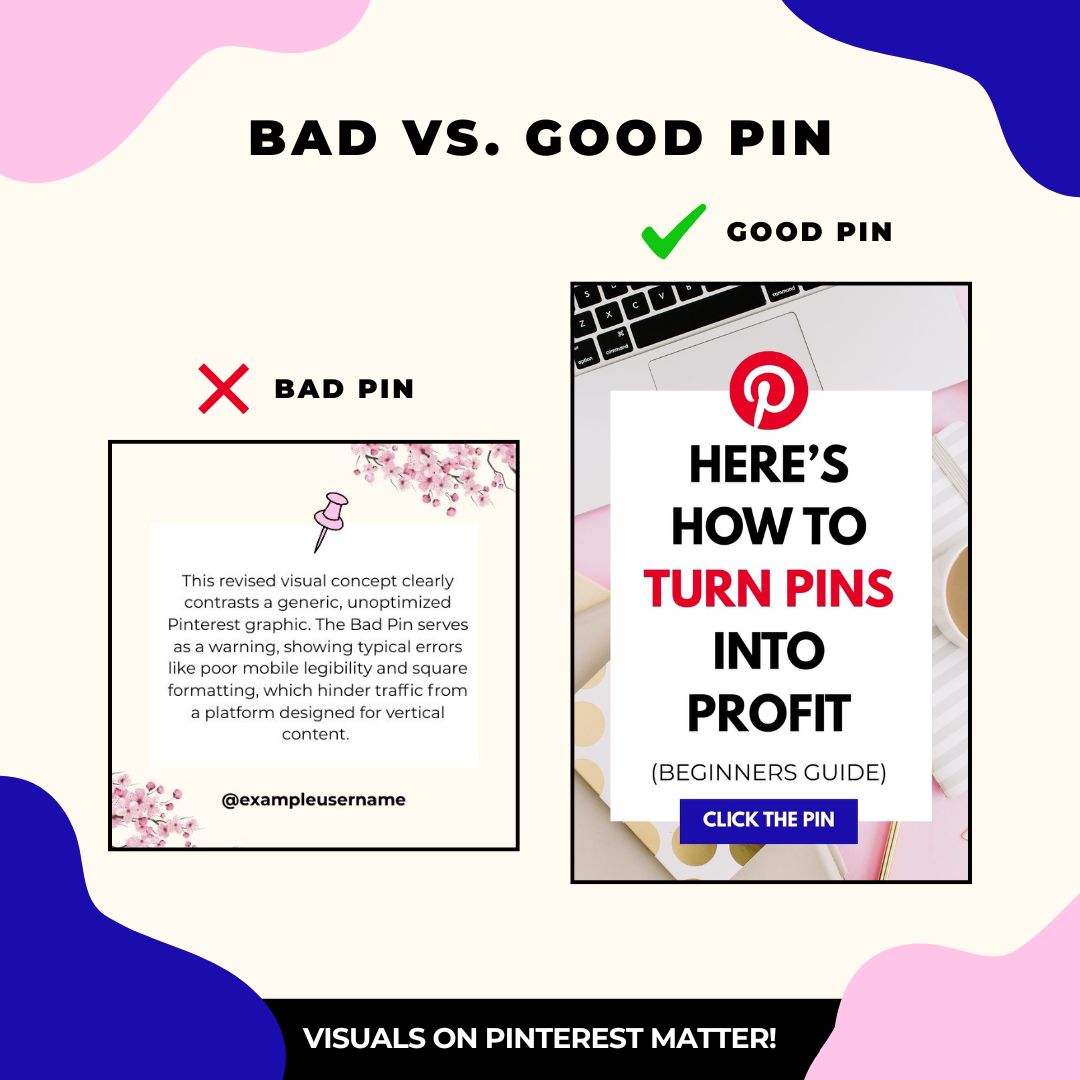
It’s not that they were doing something wrong with SEO, or that the pins themselves were bad. The issue was that the design of the pins was not going to work on that platform.
I learned this the hard way a long time ago from a YouTube video about Etsy. Following that YouTube video, I understood that my Etsy thumbnails, even though they were good, weren’t good for that platform. I changed them all. It took a lot of time, but my sales went up.
It’s the same thing with Pinterest. If you want to know what works, spy on my account, grab my exact same free templates, and read this blog about the best practices. After some time, you’ll start to notice what works for users, so they click.
Step 4. Warm Up Your Audience
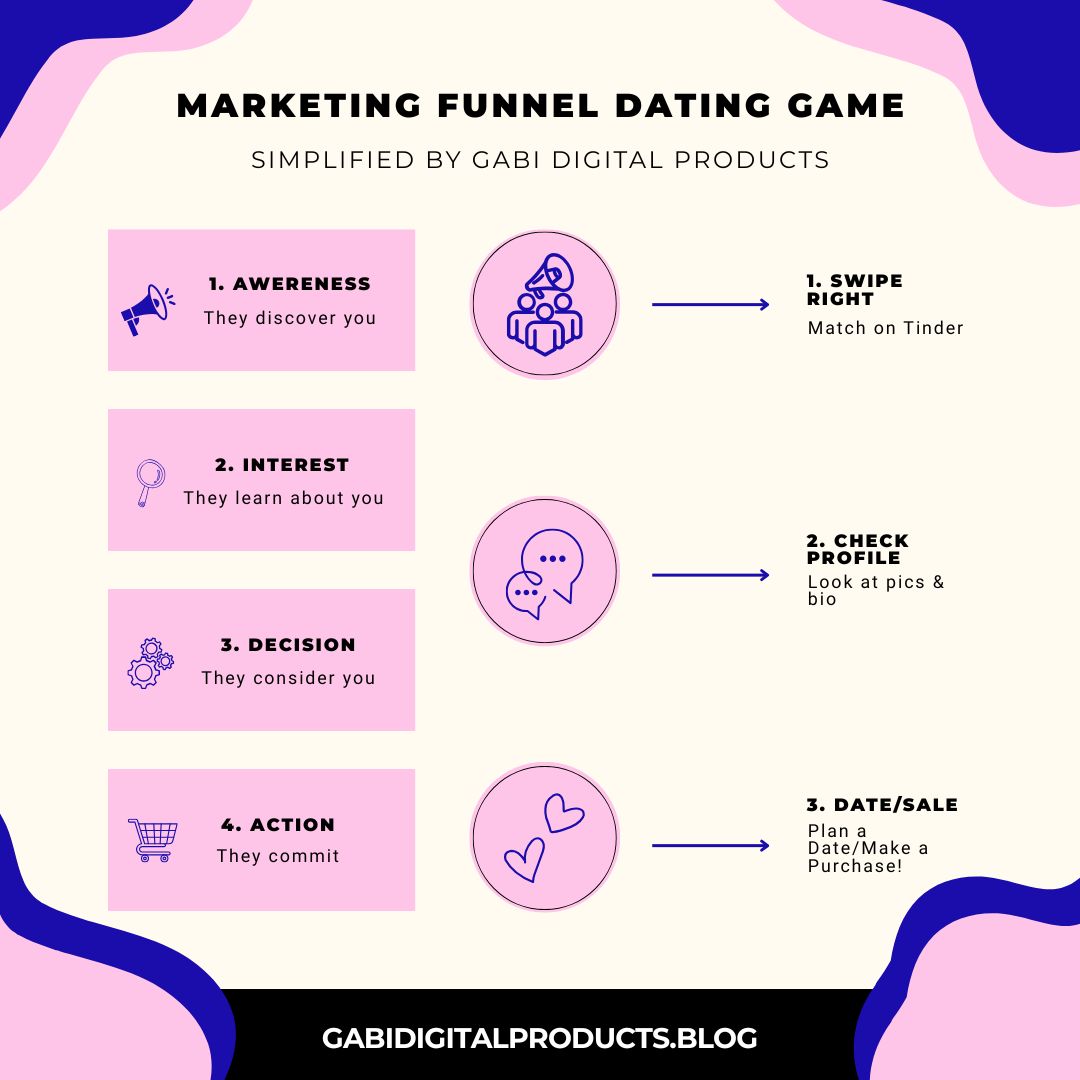
If you want to get good at marketing, always think from the perspective of dating.
First, you swipe right on Tinder to match with someone. That is awareness.
Next, you check their profile, look at their pictures, and read their description. You start to learn about them.
Then, you might start chatting with that person.
After some time, you plan dates. You go on those dates. It takes time to really get to know someone, and sometimes years before marriage.
It is the same here.
About 80 percent of your marketing should lead to a blog, a YouTube video, or a freebie in exchange for an email. You can lead someone directly to a product landing page, but here is the truth: converting a cold audience, people who have zero knowledge about you, is very hard.
Only those who already know they need your product will buy. The rest will not convert.
Step 5. Landing Page Experience Matters
Do you remember those moments when you click on a site to learn something new and you are bombarded with pop-ups, ads that even slow your phone down, and you sometimes cannot even find a button to escape as fast as possible?
Omg, that happened to me.
You know where? On Pinterest.
Yep.
The thing is, if a blog is ranking high on Google, there is a good chance the blog is actually great. Google is very smart.
But on Pinterest, engagement can be amazing, so your pin might get pushed even if the landing page is awful.
The problem is, if your pages load slowly, if you bombard visitors with ads, or if you have millions of pop-ups, people will bounce.
And when they do, Pinterest is starting to notice. If users leave your page too quickly, your pin could be penalized and shown less often.
Google will also lower your rankings as a result.
Always, always, always think about the user’s experience when they land on your site. Make sure it loads fast. Make sure it has a modern design. Poor designs will not cut it. Avoid too many colors, too many animations, or anything that feels scammy. Make your call-to-actions clear.
A simple, clean, beautiful, fast-loading site will always win.
Step 6. Commit to The Long Game
I am not new Pinterest. I have had accounts for various purposes, so when I started my new one with the goal to sell digital products, I knew what I was doing.
But I still struggled insanely. I told my friend, many evenings, that I was tired. I spent so much time, and nothing was working. I felt like I was just wasting my time.
I know it is hard.
But you have to push through that hard period. There is just no way around it, I am sorry to tell you that.
I went through this as well.
And now, I have a growing account with 1M impressions, visitors to my sites, and buyers of my digital products, all because I pushed through the hard times.
Bonus. Study What Is Already Performing
Your competitors have already done a lot of the hard work for you. They found the right keywords and created pins that people like. This realization is what helped my account grow so fast.
I keep a secret board where I save pins that catch my attention. When it’s time to create my own content, I get inspiration from these pins. Important: I never copy them. Copying can get you into trouble, but inspiration is fine. I make my own version, and usually a better one. Nine times out of ten, it can go viral.
Also, on Pinterest, even small details matter. For example, if I make gift guides (always with disclosure), one pin might show pillows and blankets for autumn, while another shows autumn food and other seasonal items. The food pin might go viral, while the pillow pin underperforms. Little things like that attract people’s attention, so keep them in mind and pay attention to the details.
The same logic applies to your products, not just your pins. A template collection built for one specific audience tends to convert better than something generic, that’s exactly why I designed my 200 Instagram Templates for Teachers around one clear niche instead of a broad “for everyone” bundle.
One More Bonus
When you get a save, go to that pin. There should be a button that shows which boards the pin was saved to, if the account is public.
That board can tell you a lot about your audience’s interests.
How did I find out that they like food in the gift guides?
By studying people’s boards that saved my pins and noticing the same patterns again and again.
And last bonus, I promise!
Hop on seasonal trends.
Halloween is coming? Make Halloween-inspired designs.
Christmas? Adjust your marketing to that.
If you do not, your competitor who does will be pushed ahead.
Step 7: Don’t Forget to Come Back Next Weekend for More Tips Like This!
I appreciate your time and your decision to read my blog. I truly hope it helps! Have an awesome rest of your day.
Gabi ❤️
P.S. Don’t forget to steal my templates to outrank your competitors 🤫