This post contains affiliate links. As an Amazon Associate I earn from qualifying purchases. I may also earn commissions from other affiliate programs at no extra cost to you. Please read full disclosure for more information.
Imagine selling a digital product you did not even create.
With done-for-you digital products, this is possible, even for a complete beginner.
Do you want to know how it works? Let’s find out.
What Is a Done-for-You Digital Product?
It’s simply a digital product, like a clipart bundle, social media templates, slide templates, or really anything, for which the seller provides a resell license. You can buy it, resell it, and profit from it.
Ready to Sell? Here’s How
Step 1: Find Your Perfect Product (and Niche) to Start Selling Today
There are thousands of digital products out there. But if you’re a beginner, finding the best done-for-you digital products that fit your niche can be a real challenge. You want something that aligns with your brand and is easy to promote.
If you are in the fitness niche, for example, a cookbook of healthy recipes could be perfect for you.
For the wellness niche, a bundle of digital self-care journals could be a perfect fit.
Want to get started right now? I’ve put together a free pack of done-for-you Canva templates you can steal and start selling.
Step 2: Choose Your Platform: The Marketplace vs. Your Own Website
Everybody likes Etsy.
Why? Because it’s a huge marketplace packed with buyers.
But here’s the thing. If you sell on your own website… it’s not a marketplace. You won’t have people just running to your store. You’ll have to bring them there yourself.

And there’s a bigger problem.
With Etsy and ready-made digital products, it’s actually against their TOS. In other words, on Etsy, you must sell unique products.
A lot of people just ignore this. But I want you to know the truth.
So what’s the solution?
Simple. Customize that done-for-you digital product so much that it becomes unique. Or… sell it on your own website.
“Website scares me!”
I know it scares you.

I was scared too… until I found Fourthwall. And I’ll tell you this—I love it. And no, this isn’t an ad. I don’t get paid for recommending it. This is just my honest recommendation.
Now, let’s be real. It’s not Shopify. It’s more limited. But here’s the big difference: Fourthwall is a merchant of record. And that simplifies everything for you.
At the start, it’s free. But if you want to post more than 50 products, you’ll need to pay for that feature. Until then, you don’t need to pay for anything.
Again, it’s not Shopify, as I said, so if you’re looking to run a professional e-commerce store with 500 products, this isn’t it.
I mean, it kinda is…and kinda isn’t. Having a clean, professional shop with lots of products on Fourthwall isn’t going to be as easy as it would on Shopify. But, you can have it.
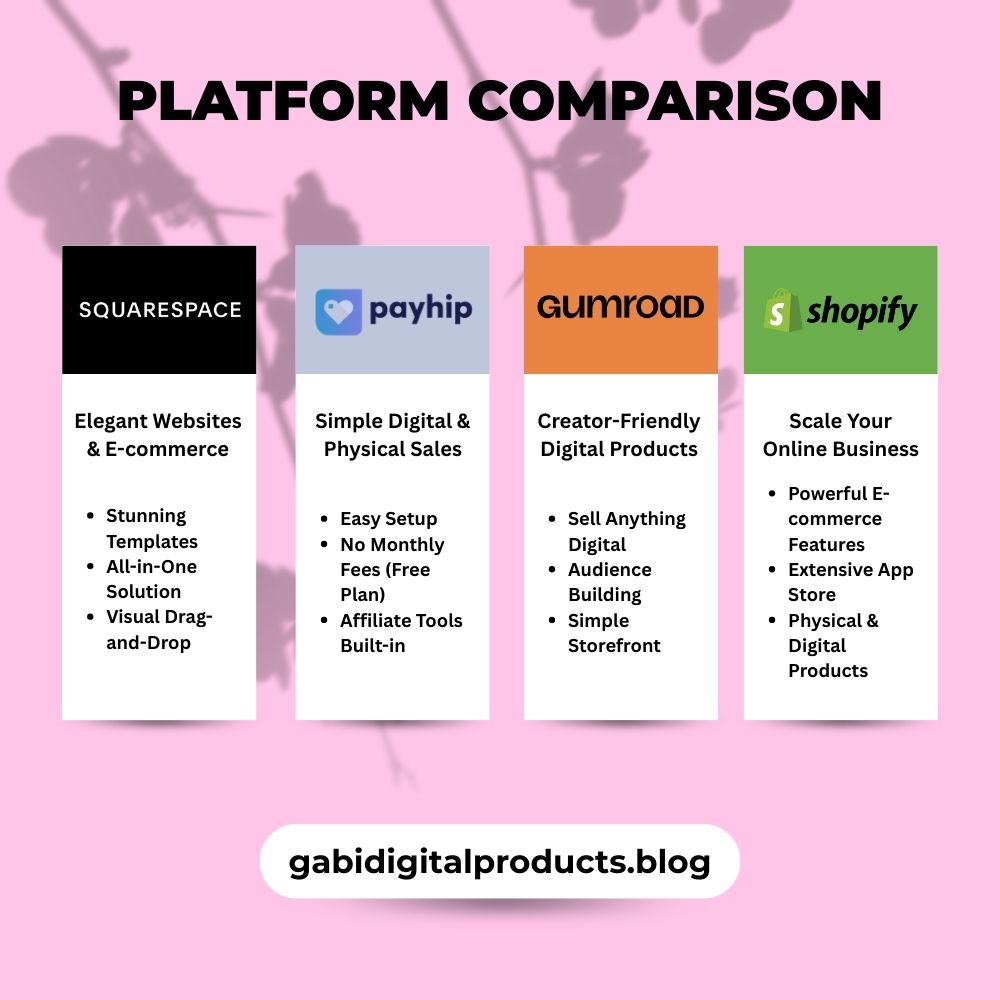
Of course, you could do your own research. Squarespace, Wix, Gumroad… there are plenty of platforms out there. But, if it’s not a merchant of record, things get much harder. You’ll have to deal with a lot of stuff that has nothing to do with creating and listing your digital products.
A Mini Recommendation from Gabi
I am a huge believer in securing your financial stability.
Here’s the truth: on a marketplace, one day you can make a lot of sales. The next day, you might make almost nothing. It’s very unpredictable and depends on algorithm changes.
Marketplaces are good, but they keep changing their rules. You have to keep adjusting. It gets tiring.
That’s why I made my site on Fourthwall. I can make it cute, sell without stress, and most importantly, I am not on a rollercoaster all the time.
I bring people to my store with SEO and social media. Even if Google changes its rules, people still come from social media. That means my sales stay pretty much steady.
To marketplaces, yes, you can bring people from social media too to keep sales steadier. But they don’t convert as much in my experience there as they do on your website. A website adds that extra layer of credibility and trust.
The bottom line? Don’t put all your eggs in one basket. This is never a good idea.
But having both a website and a shop on a marketplace is time-consuming and challenging, so always do things at your own pace.
Reselling Digital Products Safely
You can sell done-for-you digital products as they are. You don’t have to change them. But you must get them from someone you trust. If you sell something stolen, you can get in big trouble.
That’s why everything in my store is made by me.
Most of the time, you don’t know how others made their products or where they got them.
I said it once and I will say it again. Stay away from those 1,000-product bundles for 1 euro. I’ve seen on Reddit that people’s artwork gets stolen and thrown into these bundles. It’s risky and could get you into big trouble.
Only buy from people you trust.
Step 3: It’s Time to Sell: List It, Promote It, and Profit!
If it doesn’t get listed, it doesn’t get sold.
- List your product.
- Promote it.
- Promote it again!

Always pick a product that you truly believe in. Something you really like. This makes promotion much easier. People will feel your passion and want to buy it, instead of you pushing something you have zero clue about.
“But, Gabi, what’s the best product to sell?”
You might be asking what the best done-for-you digital products are to sell. In my experience, the ones that sold the most were:
What do they all have in common? They solve a very specific pain point: time. These templates take a lot of time to create from scratch, so it’s no wonder they sold the most.
What about for you? What will be your bestseller?
It depends.
But here’s the secret: if you create or pick a ready-made product that solves a painful problem — any of them can be a great product to list. And of course, it has to align with your customer.
The Complete 3-Step Guide to Ready-Made Digital Products to Resell
- Step 1: Pick a product. Everybody wants a product they don’t have to create. It’s the easy path. But here’s the thing: on a site like Etsy, you have to be unique. Don’t just sell the product—make it your own. If you want to resell products pretty much as they are, look into creating your own website.
- Step 2: Pick a platform. A website? A marketplace? That choice is up to you. But the bottom line is this: you must never put all your eggs in one basket. It’s the simplest rule in business, and it’s one you can’t afford to ignore.
- Step 3: Start selling. If your product isn’t listed, it won’t be sold. That’s obvious. But the next step is the one that most people forget. If it’s not promoted, it has almost no chance of being seen. So after you list it, don’t forget to promote.
And if you are still scared after reading this post and don’t know where to start, know that I was too. I started out being scared, but I did things despite the fear.
Don’t be that person who reads and does nothing.
Don’t let fear shape your future.
Sending you lots of hugs, Gabi <3.