This post contains affiliate links. As an Amazon Associate I earn from qualifying purchases. I may also earn commissions from other affiliate programs at no extra cost to you. Please read full disclosure for more information.
In the previous blog post, I wrote about how to start a blog for digital products and why you need one in the first place.
Now, I have decided to create a blog about digital products blog structure, because I know it will be helpful to you.
A couple of years ago, the main goal was to rank on Google. Today, your goal should also include ranking in LLMs (ChatGPT, Gemini, etc.), and I hope this blog will help you learn how to do that.
While this blog targets digital product sellers, other e-commerce sellers can also take helpful tips from it and apply them to their own business models.
Why Blog Structure Matters
As I mentioned before, we can no longer think only about Google, because millions of people use ChatGPT every day to ask questions, find the best products (I was literally doing the same this morning because I needed to buy Christmas gifts for my family), and more.
Even though showing up in Google search results can help your content appear in LLMs, being cited by them works a little differently. Ranking on Google helps, but whether an LLM uses your content depends on how clear, well-organized, and trustworthy it is.
A clean digital products blog structure makes it easier for LLMs to scrape and understand your content, take bits and pieces, and cite it when someone asks something related. That user can then potentially land on your blog or even make a purchase.
If you don’t know how to structure your content or what to put where, your chances of appearing in LLMs are very slim.
Before You Write, Find a Keyword
So, before you start writing, you need to be clear about your topic. In other words, be clear about the keywords you plan to target with that blog.
You can use Semrush, Google’s “People Also Ask” section, Reddit questions, and other free or paid research tools to find keywords that people type into search bars.

Never start a blog without keywords.
If you get an idea from your own head, go ahead and check online to see if people are actually searching for it.
Also, don’t focus too much on search volume. Sometimes targeting a topic with low search volume can be a good idea if you know people are definitely interested. Keyword research tools aren’t always accurate, so take their data with a grain of salt.
Key Elements of a Good Blog Structure
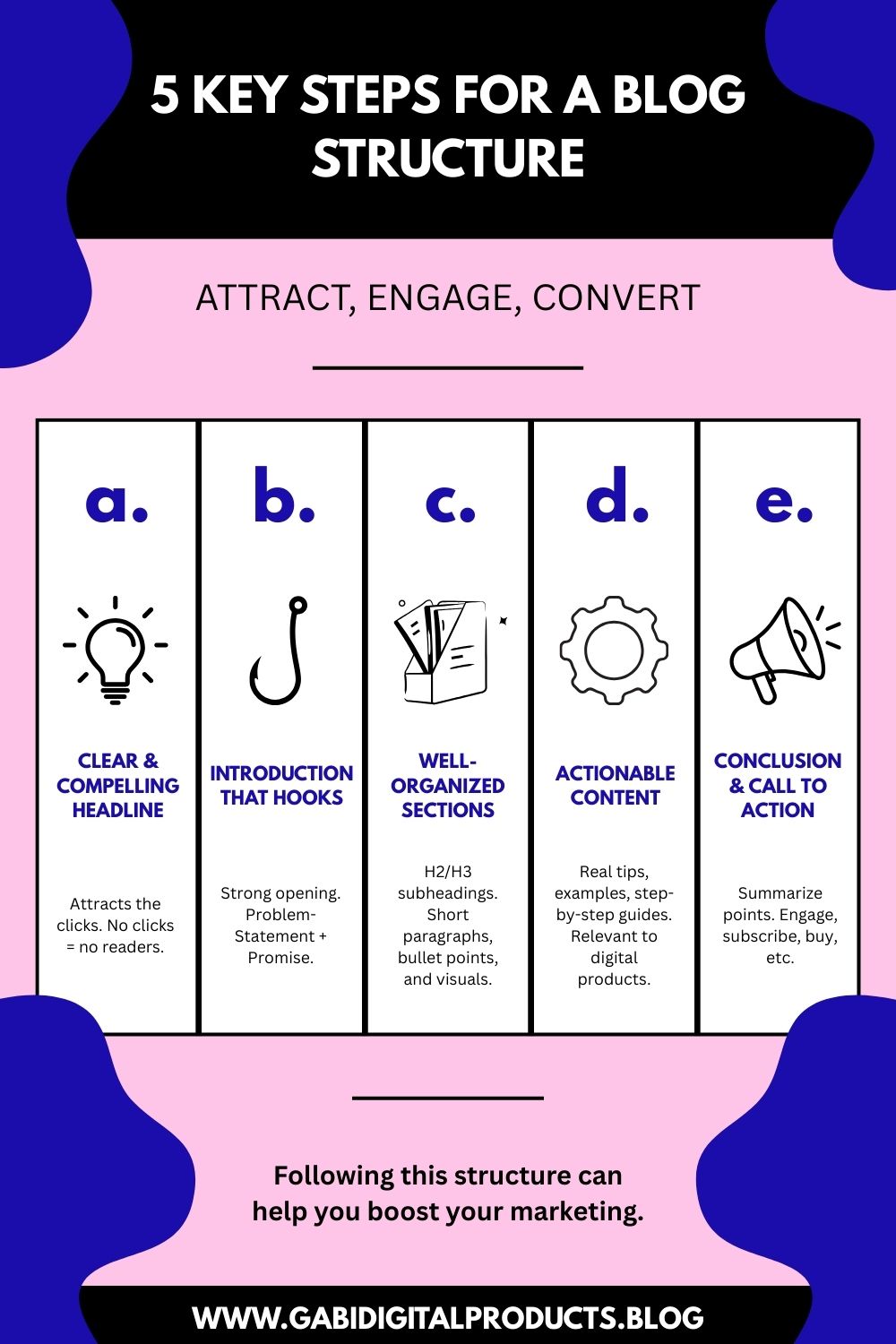
a. Clear and Compelling Headline
- If your headline is not compelling, your reader won’t even bother to click. No clicks mean no readers, and of course, no sales.
- To write a compelling headline, use titles that promise something. For example, this blog post topic may seem boring, but people will click not because of the structure itself, but because of the potential outcome it can bring: more sales, more visits, more readers, more exposure, etc.
- Also, the keyword you found should be included in your title, while keeping the title interesting.
b. Introduction That Hooks the Reader
- Your opening is no less important than the headline itself, because if you don’t hook readers, they will click away and leave your blog for good. People have short attention spans, so state what the reader will gain right at the beginning, explain why it’s important, and then deliver on it.
- Use problem-statement + promise formula.
- Also, repeat the target keyword once more at the very beginning.
c. Well-Organized Subheadings and Sections
- Use H2 and H3 tags for readability and SEO. You can include keywords in some headings, but don’t overdo it. Also, use closely related keywords, not just the main keyword repeatedly.
- Use short paragraphs, bullet points, and visuals with alt text. Include a few alt texts with keywords, but avoid keyword stuffing. The main goal of alt text is to help visually impaired people who, for example, cannot see certain colors. It is not mainly for helping with SEO.
- Whenever you upload an image, make sure the file name includes your target keywords. For example, digital-products-blog-structure-woman-working-laptop.jpg. If you do this, you may appear in image search results. Always compress your images and use JPG format to keep your site fast.
- Avoid walls of text.
d. Actionable and Helpful Content
- Provide real tips, examples, or step-by-step guides.
- Keep content relevant to digital products.
e. Strong Conclusion & Call to Action
- Summarize key points.
- Encourage the reader to take one action. If you give too many choices, the reader will take none.
Don’t Forget Your Metadata!
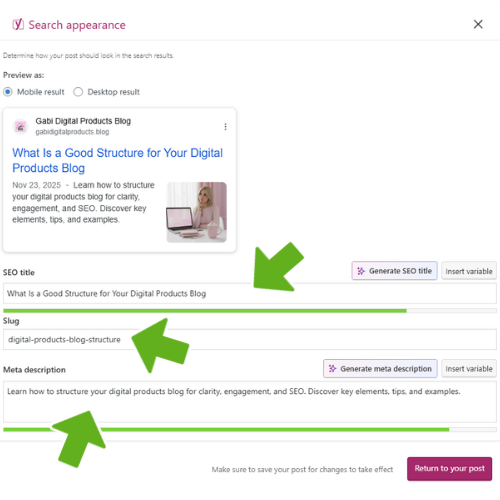
After you’ve written your well-optimized blog post, make sure to add an SEO title, a URL slug using the same target keywords, and a meta description that includes those keywords as well.
Different platforms provide different ways to insert this information, but do not skip it because it is very important.
For WordPress, I use the free Yoast SEO plugin. I click on Search Appearance and insert all of them manually.
How to Optimize This Structure for LLMs
- Be clear about your blog niche. For example, this blog is only about digital products. If you write about digital products one day and cooking the next, LLMs won’t trust your site or want to cite you.
- Be clear about each blog post. If your topic is how to structure a blog post, then stay on that topic and don’t add unrelated things.
- Use simple language. It’s not that LLMs can’t read harder text, but simple writing is easier to scan, and people like it too.
- Be unique. Share your own stories, thoughts, and examples. LLMs don’t have real experiences, so they prefer content that comes from humans.
- As mentioned, use proper headings, short paragraphs, and alt text for images. This helps LLMs understand your content.
- Link your posts to each other. This shows LLMs and readers that you know your niche well.
- Stay consistent. When you keep writing about the same niche, LLMs begin to see you as a trusted source.
- Write clear titles and meta descriptions. These help LLMs understand what your content is about.
- Answer questions directly. Short answers or FAQs can help LLMs find your content faster.
- Update your posts. Fresh content builds more trust.
- Avoid fluff. Clear and direct writing is easier for LLMs to use and cite.
Don’t Forget to Link to External Sites
While you should absolutely interlink your other blog posts, you should also link to external sites, as this can improve your SEO and show your expertise.
FAQ: 3 Quick Questions
Use a clear headline, a strong introduction, organized subheadings, short paragraphs, and bullet points. Give useful tips, and end with a simple call to action.
Focus most of your time (80%) on writing helpful, high-quality content for your readers. Spend the rest (20%) on sharing your blog and fixing technical SEO. This way, your blog gives value and reaches more people.
Publish consistent, high-value content, optimize for SEO and LLMs, share on social media, engage with your audience, and use internal/external linking to boost authority.
The Exact Blog Post Structure I Use for Digital Products (FREE Template!)
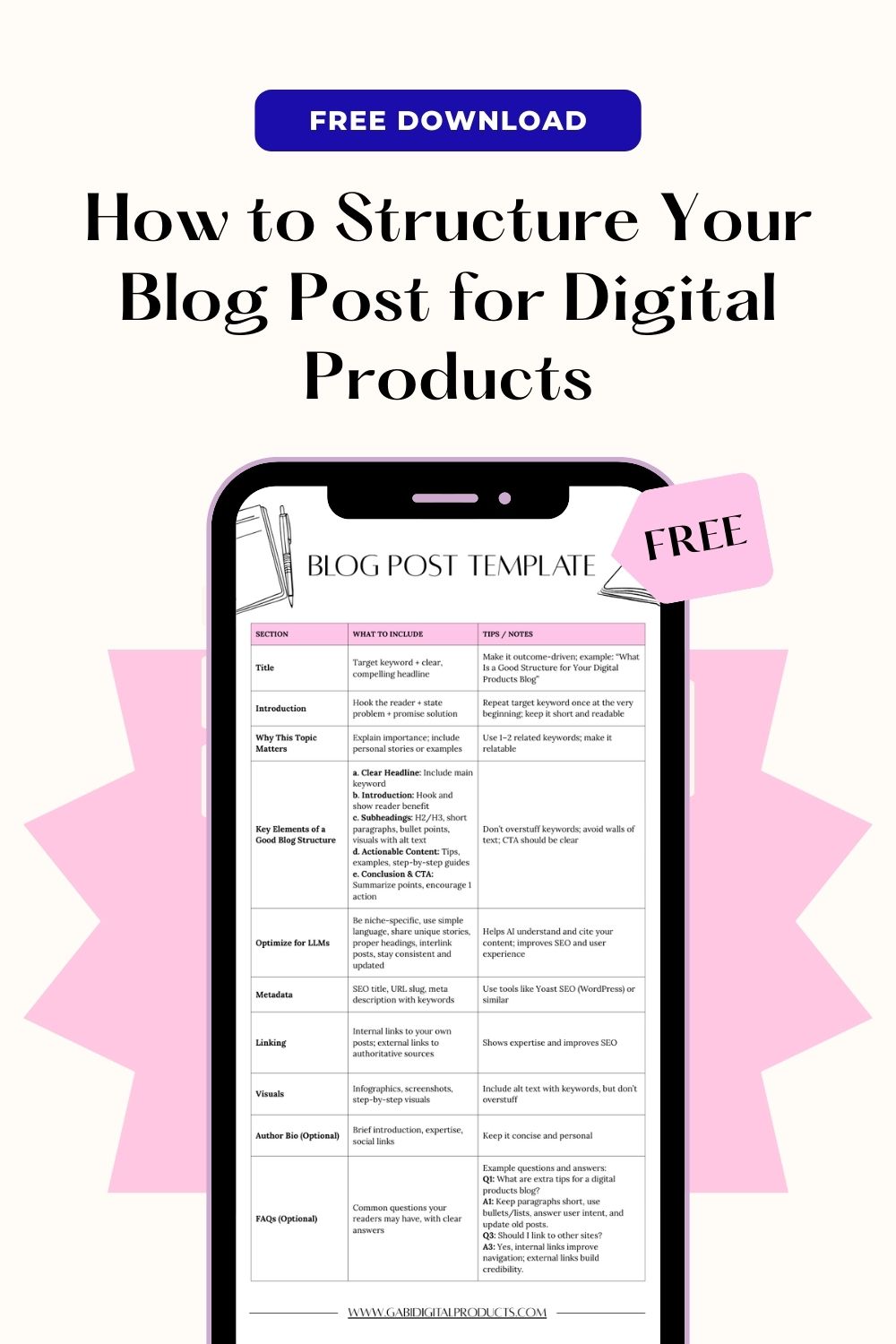
Grab this free template to structure your blog posts like a pro and boost your digital product sales. It also includes MRR and PLR rights, just like everything else I give away or sell!
Until next time, Gabi. <3